
Method · FDES configurators
How do you build an FDES configurator? The project stages
Building an FDES configurator (FDES is the French EPD format, Fiche de Déclaration Environnementale et Sanitaire) does not start with the interface. It starts with scoping and understanding your products and the data that make them vary, continues with building the LCA model, and only then moves on to developing the application, before testing and verification.
This guide is for manufacturers considering a configurator who want to know what they will need to prepare, who needs to be involved and what will be done during the project.
- Written by
- CEO and technical architect at Ailoop
- Published
- Updated
- Reading time
- 12 min

Contents
- What are the stages of an FDES configurator project?
- What data needs to be prepared?
- How does the LCA model become an application?
- How do you make the tool simple for non-experts?
- What features should you plan for?
- What can complicate an FDES configurator project?
- How do you prepare an FDES configurator project?
- Key takeaways
When people picture an FDES configurator, they think of the screen first: some fields, a button, an FDES coming out. Yet it is the last thing to be built. Before the interface, you need to understand your products, know what makes them vary and translate that into an LCA model. You also need to understand your processes, to find the best way to fit the FDES configurator into your organisation (automatic creation when a quote is entered, access for field sales teams, shared access across your teams). This guide follows the project in the order it unfolds, and sets out at each stage what you will need to prepare.
What are the stages of an FDES configurator project?
A configurator project runs in five stages: scoping the project, collecting and structuring the data, building the LCA model, developing the application, then testing it and getting it verified. The first three happen upstream, before a single line of code is written.
The five steps of an FDES configurator project
Upstream · understand and model
01 Scope the project
Products to cover, type of configurator, expected deliverables, users: the scope is set.
Scope defined
02 Collect and structure the data
Families, references, compositions, sites, processes, transport: what stays the same is separated from what varies.
Structured data
03 Build the LCA model
Assumptions, scenarios, variables, calculation rules and formulas, and the limits within which each parameter can vary.
Parametric LCA model
Then · build the tool and verify
04 Develop the application
User journey, interface, calculation engine, PDF and XML exports, input checks.
Application
05 Test and get it verified
Test configurations, then a review of the model and the application by an independent verifier approved by INIES.
Verified configurator
The order is not negotiable. Every field shown on screen corresponds to a variable in the LCA model, with its allowed values: an interface developed before the data and the model are stable will have to be reworked.
What data needs to be prepared?
There are two kinds of data to prepare: the data that builds the LCA model, gathered once, and the data the user will enter for each FDES. Where you draw the line between the two decides what will be able to vary.
Two kinds of data, one boundary
Once, to build the model
The LCA model data
- Materials and formulations
- Sites and processes
- Energy, yields, offcuts
- Supplier data
- Upstream transport, packaging
- Installation, use stage, end of life
For each FDES, by the user
The input data
- Family or reference
- Dimensions, thicknesses
- Finish
- Delivery distance
- Composition, site generator
The input framework connects the two: allowed values, ranges, forbidden combinations.
Missing or approximate data does not always block the project, but it must be identified at the scoping stage. A project that makes sense on paper may first require real work on the data: it is one of the five factors in the suitability guide.
How does the LCA model become an application?
By translating each element of the model into an element of the application: variables become fields, ranges become checks, calculation rules become the engine, and deliverables become exports.
From LCA model to application
- Variables Form fields
- Ranges and allowed values Input checks
- Calculation rules and formulas Calculation engine
- Deliverable content PDF and XML exports
Traceability of every generation: model version, parameters entered, results obtained.
You then have to prove that the application calculates correctly. This is done first with test configurations whose results are known, then through verification: an independent verifier, approved by the INIES programme (INIES is the French national EPD database), examines the model and its translation into the application. The verifier is independent of every party to the project: neither the manufacturer, nor the LCA practitioner, nor the company that developed the configurator. INIES publishes the list of approved verifiers, and the verification guide details what they examine.
How do you make the tool simple for non-experts?
By starting from what users know, not from what the model contains. A sales representative knows the product reference ordered and the construction site; a product engineer knows the formulation. Neither of them should have to handle an emission factor.
The language of the trade, not of LCA
- ProductHollow brick Composition and process of the family
- Thickness20 cm Quantity of material per unit
- FinishFlashed Associated finishing process
- Construction site postcode69003 Distance and transport to the construction site (module A4)
In practice, this means forms written in the language of the trade, step-by-step input in the order users think about their product, drop-down lists rather than free text, and error messages that say what to correct.
This is the approach taken by the DimACV configurator, designed with the CTMNC for the natural stone sector: manufacturers, often not LCA experts, describe their quarry, their processes and their formats, and the project’s methodological rules apply automatically. The DimACV project shows this user journey.
What features should you plan for?
It depends on who will use the tool, and for what. Six features come up often in projects.
Features that often come up
Accounts and permissions
Who can access what: internal teams, customers, manufacturers across a sector.
Product families
Add or edit families, within the limits of the model.
Parameters and checks
Ranges, value lists, consistency between fields.
PDF and XML exports
The FDES, the XML expected by INIES and building calculation software, a spreadsheet if needed.
Versions and traceability
Model version, parameters and results of every generation.
Integrations
Import from an ERP or a product database, or an API, depending on your systems.
What can complicate an FDES configurator project?
The main difficulty in an FDES configurator project is usually collecting the data needed for the environmental modelling, and its quality. Other factors can also affect its complexity.
- Data that is hard to collect: information on raw materials, energy consumption or manufacturing processes may be spread across several departments, production sites or suppliers.
- Very different products: some product families have compositions or manufacturing processes that require several LCA models.
- Parameters that are hard to define: you need to identify the characteristics that can vary and their limits of variation, in line with the INIES programme rules specific to the type of configurator chosen (generator or distributor).
- Data of variable quality: some information may be incomplete, not very representative or insufficiently documented.
The scoping stage identifies these issues, assesses the data available and defines a scope suited to the project.
How do you prepare an FDES configurator project?
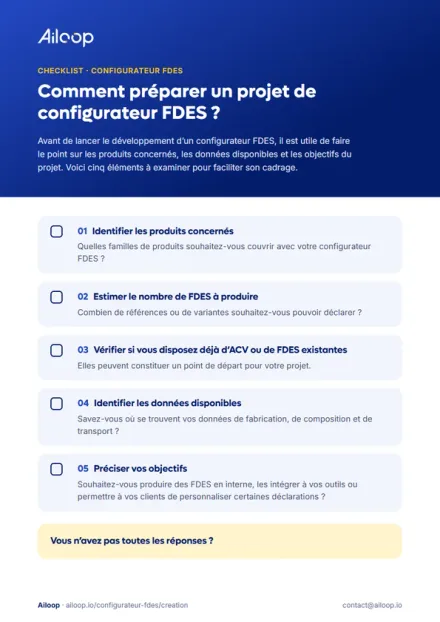
Before starting to develop an FDES configurator, it is worth taking stock of the products concerned, the data available and the project’s objectives. Here are five points to review to make scoping easier.
- 01Identify the products concernedWhich product families do you want your FDES configurator to cover?
- 02Estimate the number of FDES to produceHow many product references or variants do you want to be able to declare?
- 03Check whether you already have LCAs or FDESThey can serve as a starting point for your project.
- 04Identify the data availableDo you know where your manufacturing, composition and transport data is?
- 05Clarify your objectivesDo you want to produce FDES in-house, integrate them into your tools or let your customers customise certain declarations?
Key takeaways
An FDES configurator is both an LCA project and a software project. It has three prerequisites: products you know how to describe, data you know where to find, and a use for the FDES you can put into words. The rest is built with a team that combines both skill sets, preparing for verification from day one.
Free pre-assessment
Is your FDES configurator project feasible?
Let’s talk about your products, the data you have and your objectives, to identify the main challenges of your project and the next steps to consider.


No commitment · With an LCA expert and a digital expert
Frequently asked questions
Can you build an FDES configurator without having carried out an LCA already?
Yes. If you do not yet have an LCA, the environmental modelling can be carried out as part of the project. If you already have LCAs or FDES, they can serve as a starting point, provided you check that they fit the future configurator.
Do you need all the data before starting the project?
No. The project can start with a review of the data available and the data still to be collected. This step identifies the information needed for the LCA modelling, spots any gaps and organises their collection.
Can you start with a single product family and add others later?
Yes. A configurator can be designed to grow step by step. You can start with a first product family, then add others. Depending on their characteristics, these new families may require additional LCA models and an extension of the verified scope.
Who needs to be involved on the manufacturer’s side?
It is important to bring in the people who know the products and their manufacturing processes. Depending on your organisation, this may be the technical, production, R&D or environmental teams. A project lead also makes it easier to gather information, coordinate and sign off the different stages.
How long does it take to build an FDES configurator?
There is no standard duration. The timetable depends in particular on the number of product families, the availability of data, the complexity of the LCA models and the features expected. You also need to allow for testing, verification and, if required, the recognition process for the configurator.
Does every FDES produced by the configurator need to be verified?
It depends on the type of configurator and the applicable verification arrangements. A generator configurator may require additional verification of the declarations it produces, whereas a distributor configurator works within a more restricted set of parameters. These conditions must be defined from the scoping stage, in line with the rules of the INIES programme.
Can an FDES configurator be changed after it has been verified?
Yes. A configurator can evolve to add new features, change certain parameters or add product families. However, changes affecting the LCA models, the calculations or the verified scope may require a new verification. It is therefore important to distinguish purely functional changes from environmental ones.